India’s Fertilizer Challenges
By CD Staff 10 min read
Note4Students:
Due to global conflicts, India faces critical challenges in securing its fertilizer supply, bringing the fertilizer sector back into focus. PYQs have highlighted various agricultural supply chain issues, including irrigation and crop diversification. But this war hits global supply chains in more ways than one. As an aspirant, you can include fertilizer and agri problems in a globalization/ supply chain-related question. The Back2basics section gives you 5 perennial challenges in the Indian Fertilizer sector that are not available in standard recourses. Make notes!
Microthemes and PYQs:
- What is the present challenges before crop diversification? How do emerging technologies provide an opportunity for crop diversification? (2021)
- What are the major challenges faced by Indian irrigation system in recent times? State the measures taken by the government for efficient irrigation management. (2024)
Microthemes: GS Paper 3: Tech in Agri Production and Marketing; Cropping pattern
India’s Current Fertilizer Scenario
- Dependency on Imports:
- India’s domestic fertilizer production does not meet demand, leading to high import dependency.
- Urea: 20% imported
- Diammonium Phosphate (DAP): 50-60% imported
- Muriate of Potash (MOP): 100% imported
- 2023 Standing Committee Recommendation: Increase domestic production to reduce import dependence
- India’s domestic fertilizer production does not meet demand, leading to high import dependency.
- Production vs. Consumption:
- In 2021-22, India produced 435.95 LMT but consumed 579.67 LMT of chemical fertilizers
- Impact of Global Crises:
- Conflicts in Ukraine and Gaza lead to oil price hikes, affecting petroleum-based fertilizers. Supply disruptions from countries like Russia strain India’s import channels.
- High Fertilizer Demand:
- High demand for fertilizers during India’s rabi season, especially in states with wheat cultivation.
- Some states, like Uttar Pradesh, report only 10 days’ worth of fertilizer stock, raising concerns about availability.
Impact of Global Conflicts on the Fertilizer Market
Worldwide impacts:
- Market Instability: Conflicts in Ukraine and Gaza disrupt global fertilizer market stability, particularly impacting oil-based fertilizer prices
- Supply Chain Disruptions: Ongoing conflicts hinder supply chains, notably affecting fertilizer imports from Russia, a key supplier for India
- Price Volatility: Geopolitical tensions lead to higher oil prices, which in turn raise fertilizer costs as they are often by-products of petroleum
Its effects on India:
- Rising Import Costs: Increased global fertilizer prices elevate India's import costs, straining the subsidy budget.
- Potential Supply Constraints: India’s reliance on imports from conflict-affected regions like Russia and West Asia (including the Middle East) poses risks of reduced fertilizer availability.
- Budget Strain: India’s fertilizer subsidy allocation for 2023-24 was ₹1.79 lakh crore, with substantial amounts dedicated to both indigenous and imported fertilizers.
- Need for Self-Reliance: The conflicts highlight the necessity for India to boost domestic production, promote alternatives like nano urea, and adopt sustainable practices such as natural farming
Steps Taken by India to Ensure Fertiliser Security
| Category | Measure | Details |
| Domestic Measures | One Nation One Fertiliser Scheme | Unified branding under "Bharat" reduces competition and transportation costs. |
| PM-Kisan Samruddhi Kendras (PM-KSK) | 600+ centers offering seeds, fertilisers, soil testing, and agricultural tools nationwide. | |
| Subsidy Programs | ₹2.56 lakh crore (2022-23) doubled subsidies under Urea and Nutrient-Based Subsidy (NBS) schemes. | |
| Boosting Domestic Production | Revival of urea plants in Gorakhpur, Talcher, Barauni, etc., with an expected output of 6.5 million tonnes/year. | |
| Nano-Urea Production | Target of 5 million tonnes by 2025 to reduce reliance on traditional urea imports. | |
| Enforcement Measures | Fertiliser Flying Squad seized 70,000+ counterfeit urea bags to curb illegal trade and black marketing. | |
| International Efforts | Import Diversification | Fertiliser imports from Russia increased by 323.8% in 2022-23, reducing dependence on China. |
| Long-Term Agreements | Deals with Morocco (TSP and DAP), Saudi Arabia (phosphatic fertilisers), Jordan, Israel, and Canada (MOP). | |
| Investments in Mineral-Rich Nations | Indian firms acquired stakes in Senegal’s rock phosphate reserves. | |
| Favorable Pricing from Russia | Benefited from Russian discounts and quotas, securing cost-effective imports. | |
| Subsidies and Financing | Targeted Subsidies | Urea and NBS subsidies ensure stable domestic prices despite international disruptions. |
| PM PRANAM Scheme | Promotes organic fertilizers and alternative nutrients with state-level incentives. | |
| Infrastructure Development | Expanded Testing and Distribution | Development of nationwide testing centers and improved logistics for timely availability. |
Way Forward
- Reduce Import Dependency: Strengthen domestic fertilizer production through technological advancements, nano-urea expansion, and reviving idle plants.
- Promote Sustainable Practices: Encourage balanced nutrient management and organic fertilizers to reduce over-reliance on chemical fertilizers.
- Diversify Supplier Base: Continue exploring long-term collaborations with mineral-rich nations to ensure supply stability.
- Rationalize Subsidies: Implement targeted subsidies to manage fiscal burdens effectively.
- Climate-Resilient Agriculture: Invest in sustainable farming practices to address the twin challenges of fertilizer demand and climate change.
- Infrastructure Development: Expand testing and distribution networks, especially in underserved regions.
BACK2BASICS : Types of Fertilizers
Fertilizers can be categorized based on the nutrients they provide:
| Category | Description | Examples |
|---|---|---|
| Primary Fertilizers | Supply essential nutrients like nitrogen, phosphorous, potassium | Urea (Nitrogen), DAP (Phosphorus), MOP (Potassium) |
| Secondary Fertilizers | Provide other macronutrients, excluding N, P, K | Sulphur |
| Micronutrient Fertilizers | Provide essential micronutrients | Iron, Zinc |
CHALLENGES OF THE FERTILIZER SECTOR IN INDIA
| Challenge | Description | Example |
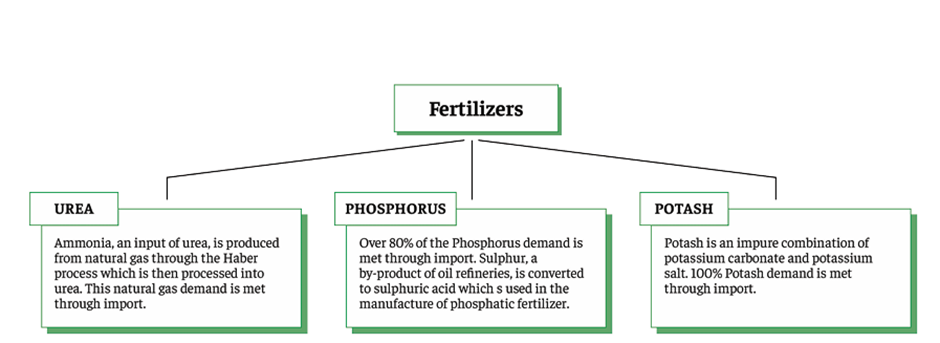
| Dependency on Imports | India heavily depends on importing raw materials, making the country vulnerable to fluctuations in prices and supply. | India imports about 90% of its phosphatic and potassic fertilizers. During the 2022 Ukraine-Russia conflict, there were sharp price hikes due to supply disruptions. |
| Imbalanced Fertilizer Use | Excessive use of urea leads to soil health issues by depleting essential nutrients like phosphorus and potassium. | From 2010 to 2020, urea use rose by 24%. States like Punjab reported reduced soil fertility and crop yields due to overuse of urea. |
| Subsidy Burden | Fertilizer subsidies put a heavy strain on government finances and often do not reach the intended farmers effectively. | In 2022-23, fertilizer subsidies reached ₹2.25 lakh crore, with inefficiencies causing high leakage and wastage in distribution. |
| Environmental Impact | Overuse of fertilizers causes soil degradation, water pollution, and contributes to greenhouse gas emissions. | Excess nitrogen from urea runoff pollutes rivers and groundwater. India is one of the largest emitters of nitrous oxide due to fertilizer overuse. |
| Slow Adoption of Alternatives | Bio-fertilizers and nano-fertilizers are underused due to low awareness and limited incentives for farmers to switch. | Despite government support, bio-fertilizers account for only about 2% of total fertilizer use. The adoption of nano-urea has been slow due to limited awareness and distribution. |