UPSC Mains 2022 · 10 marks
Discuss in detail the photochemical smog emphasizing its formation, effects and mitigation. Explain the 1999 Gothenburg Protocol.
Photochemical smog is a secondary air pollutant formed when sunlight reacts with nitrogen oxides (NOx) and volatile organic compounds (VOCs) to produce oxidants like ozone and create a brownish haze in urban atmospheres.
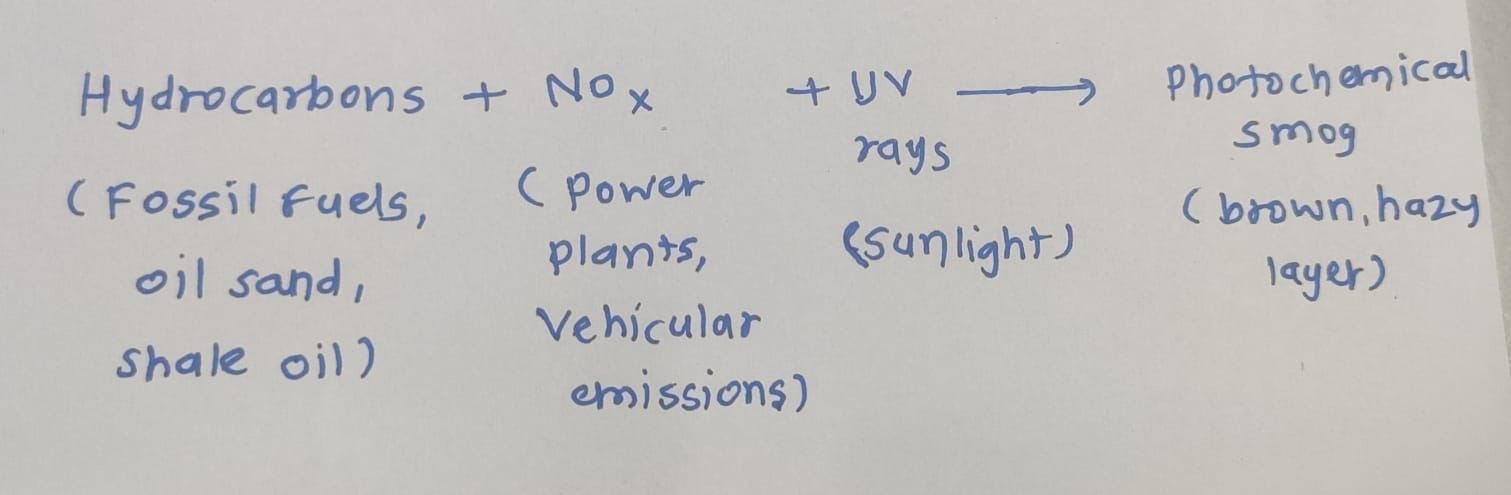
Effects of Photochemical Smog
Human Health Impacts - Causes respiratory irritation, asthma, reduced lung function and cardiovascular stress.
In 2021, air pollution caused 2.1 million deaths in India (State of Global Air Report 2024)
Crop Damage - Ozone leads to leaf chlorosis, reduced photosynthesis and lower yields. Eg- Wheat and soybean show high ozone sensitivity.
Material Degradation - PAN and ozone corrode rubber, plastics, textiles and paints.
Reduced Visibility - affect transport and aviation safety. Eg- Delhi in winter
Mitigation of Photochemical Smog
Vehicular Emission Control -
Use catalytic converters to reduce Nitrogen and carbon monoxide emissions,
Expand EV network
Regulatory measures - Odd-even and congestion pricing (London Model)
Industrial Pollution Reduction - Installation of scrubbers, VOC capture systems.
Waste to energy - Eg- biofuels from agriculture waste in Punjab, Haryana
High-resolution air quality monitoring network at the construction site linked to automatic sprayers, mist cannons, or sprinklers to reduce dust
Expand Urban Green Infrastructure - Eg- Singapore’s green urban planning
Air Quality Forecasting & Alerts - Eg- GRAP-like measures during smog episodes.
1999 Gothenburg Protocol
Protocol to the UNECE Convention on Long-Range Transboundary Air Pollution (LRTAP)
Sets national emission ceilings for SO₂, NOx, VOCs and ammonia (NH₃).
Binding country-specific reduction targets for harmful emissions.
Updated in 2012 to include fine particulate matter (PM2.5) and black carbon.
Monitoring and Reporting Mechanism for transparency and accountability
Adopting WHO’s 4 Pillar Strategy is essential to achieve Clean India
Expanding the knowledge base
Monitoring and reporting
Global leadership and coordination
Institutional capacity strengthening
Syllabus topic
GS3-18.Conservation, Environmental Pollution and Degradation, Environmental Impact Assessment.