Ocean currents are continuous, directed movements of seawater generated by a combination of physical, climatic, and planetary forces. They regulate heat distribution, nutrient circulation, marine productivity, and global climate.
Forces Influencing Ocean Currents
Solar Energy- Differential heating at the equator causes water to expand and rise slightly, creating a gradient that initiates water flow. Eg- Gulf Stream transporting warm water to Europe.
Temperature Gradients- Cold water is denser and sinks, while warm water is lighter and rises, driving vertical circulation.
Planetary winds - Trade winds and westerlies drive surface currents. Eg- North Equatorial Current driven by trade winds.
Coriolis Force- Earth’s rotation deflects moving water to the right in the Northern Hemisphere and the left in the Southern Hemisphere, forming massive circular Gyres.
Salinity Variations- High salt content increases water density. The interplay of temperature and salt creates the Thermohaline Circulation (The Global Conveyor Belt).
Continental Configuration- Landmasses deflect currents. Eg- the Brazilian coast bifurcates the Atlantic South Equatorial Current.
Gravitational pull of Moon and Sun - Generates tidal currents. Eg- Strong tidal currents in Bay of Fundy.
Ocean basin topography - Submarine ridges and basins redirect flows. Eg- Mid-Atlantic Ridge influencing deep circulation.
Atmospheric pressure systems - Cyclones and anticyclones alter local currents. Eg- Seasonal reversal in Indian Ocean currents.
Role of ocean currents in the fishing industry
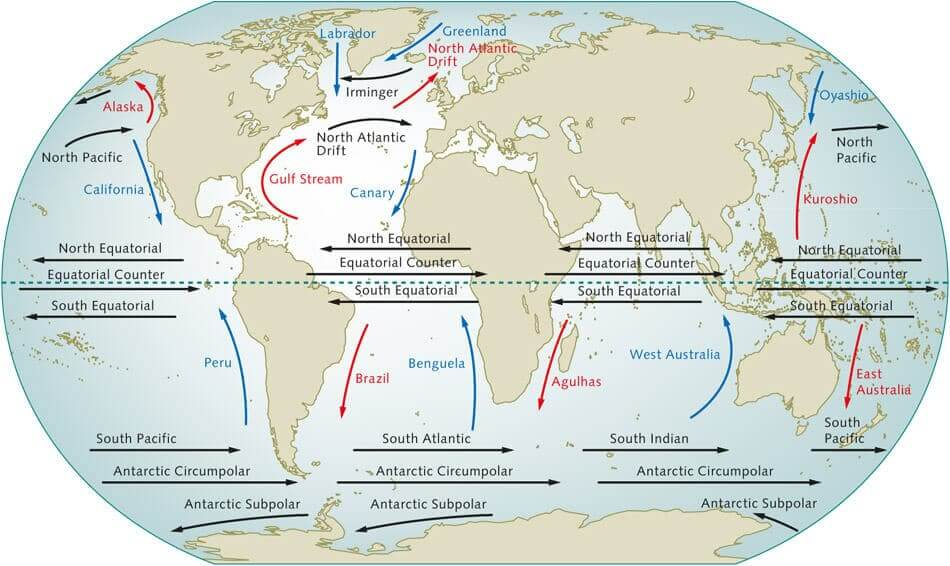
Convergence of warm and cold currents - Enhances plankton growth. Eg- Grand Banks (Labrador + Gulf Stream).
Nutrient redistribution - Currents spread plankton across oceans. Eg- North Sea fisheries supported by Atlantic Drift.
Temperature regulation - Determines species distribution. Eg- Tuna migration along warm Kuroshio Current.
Oxygenation of waters - Supports marine biodiversity. Eg- Upwelling off Namibia (Benguela Current).
Transport of fish larvae - Currents aid breeding and dispersal. Eg- Japanese fisheries influenced by Oyashio Current.
Formation of rich continental shelf fisheries - Interaction of currents with shallow waters. Eg- Dogger Bank in the North Sea.
Climate moderation for fishing communities - Eg- Gulf Stream moderating European coasts.
Fishermen follow current-driven seasonal fish migration patterns. Eg- Monsoon-linked fishing cycles in Arabian Sea.
El Niño impacts - Disrupts upwelling and fish stocks. Eg- Collapse of Peruvian fisheries during strong El Niño years.
Climate variability and disruptions like El Niño increasingly threaten these systems, highlighting the need for sustainable and climate-resilient fisheries management.
Syllabus topic
GS1-11.Salient Features of World Physical Geography
Syllabus mapping