UPSC Mains 2025 · 10 marks
What is Carbon Capture, Utilization and Storage (CCUS)? What is the potential role of CCUS in tackling climate change?
CCUS refers to a suite of technologies that capture CO₂ emissions from different sources, and utilise it in industrial processes or store it underground in geological formations.
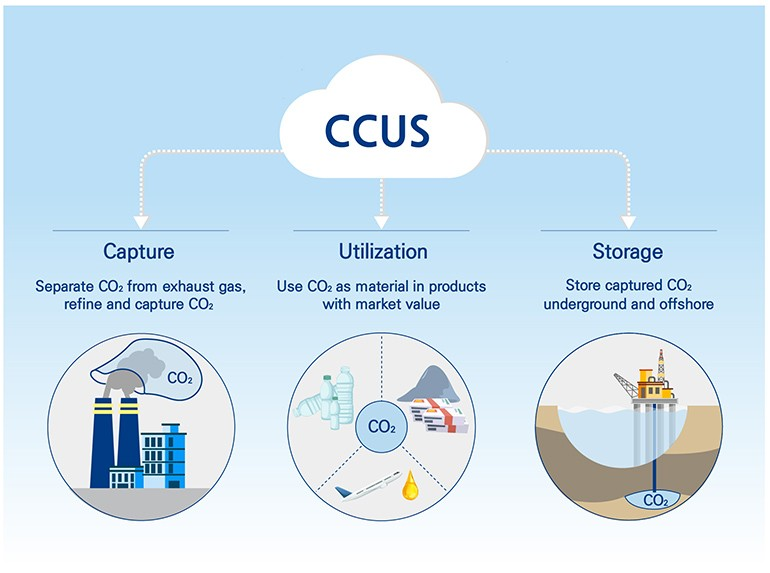
Potential Role of CCUS in Tackling Climate Change
Reduction of Industrial Emissions - Essential for hard-to-abate sectors (cement, steel, refineries) where alternatives are limited.
Support for Net-Zero Goals by complementing renewables and hydrogen.
Negative Emissions - Combining bioenergy with CCUS can generate negative emissions by removing CO₂ already in the atmosphere.
Energy Transition Support - Allows continued use of coal, oil, and gas during transition. Eg- Retrofitting coal power plants with CCUS.
Utilization for Economic Value - Converts CO₂ into value-added products (synthetic fuels, green chemicals, carbonated beverages).
Mitigation of Climate Risks - keeping global warming below 1.5°C-2°C (Paris Agreement).
Promotes Carbon Circular Economy - Eg- CO₂ mineralisation to produce green cement.
Geological Potential in India - Studies suggest India has 400-600 Gt CO₂ storage capacity in depleted oil & gas reservoirs and saline aquifers.
Challenges in Artificial Carbon Sinks
High Costs and Limited Affordability - Eg- Direct Air Capture (DAC) costs around $250-$600 per tonne of CO₂ removed (IEA, 2022), while planting trees costs less than $50/tonne.
High Energy Use and Carbon Footprint Risk - A 2021 study in Nature Energy found that DAC powered by natural gas could re-emit up to 30% of captured CO₂.
Storage Risks - Eg- claims of leaking in Weyburn project in Canada in 2011.
Delays in Deployment and Lack of Scale - As of 2023, all DAC facilities worldwide together remove less than 0.01% of annual global CO₂ emissions (Global CCS Institute).
Moral Hazard: Risk of Reducing Pressure to Cut Emissions was highlighted in the UNEP Emissions Gap Report (2022), warning against "over-optimism in carbon removal pathways."
North-South Divide - Rich countries and large corporations dominate carbon removal tech, leaving developing nations behind in access and decision-making.
Way Forward
Scale up CCS and DAC technologies with funding, incentives, and carbon pricing to meet net-zero targets. (IEA, 2021)
Include engineered carbon removal targets in Nationally Determined Contributions (NDCs). (IPCC AR6, UNFCCC COP26)
Invest in R&D to lower DAC costs to below $100/tonne and support pilot-scale deployment.
Combine artificial sinks with nature-based solutions like afforestation and soil carbon sequestration.
For India, CCUS provides a pathway to decarbonization without compromising energy security.
Disaster Management
Disaster Management Policy
Syllabus topic
GS3-18.Conservation, Environmental Pollution and Degradation, Environmental Impact Assessment.