International Relations/Regional Groupings
Asia-Pacific Economic Cooperation (APEC)
Why in the News?
The 32nd APEC Economic Leaders’ Summit (2025) is being held in Gyeongju City, South Korea
About Asia-Pacific Economic Cooperation (APEC):
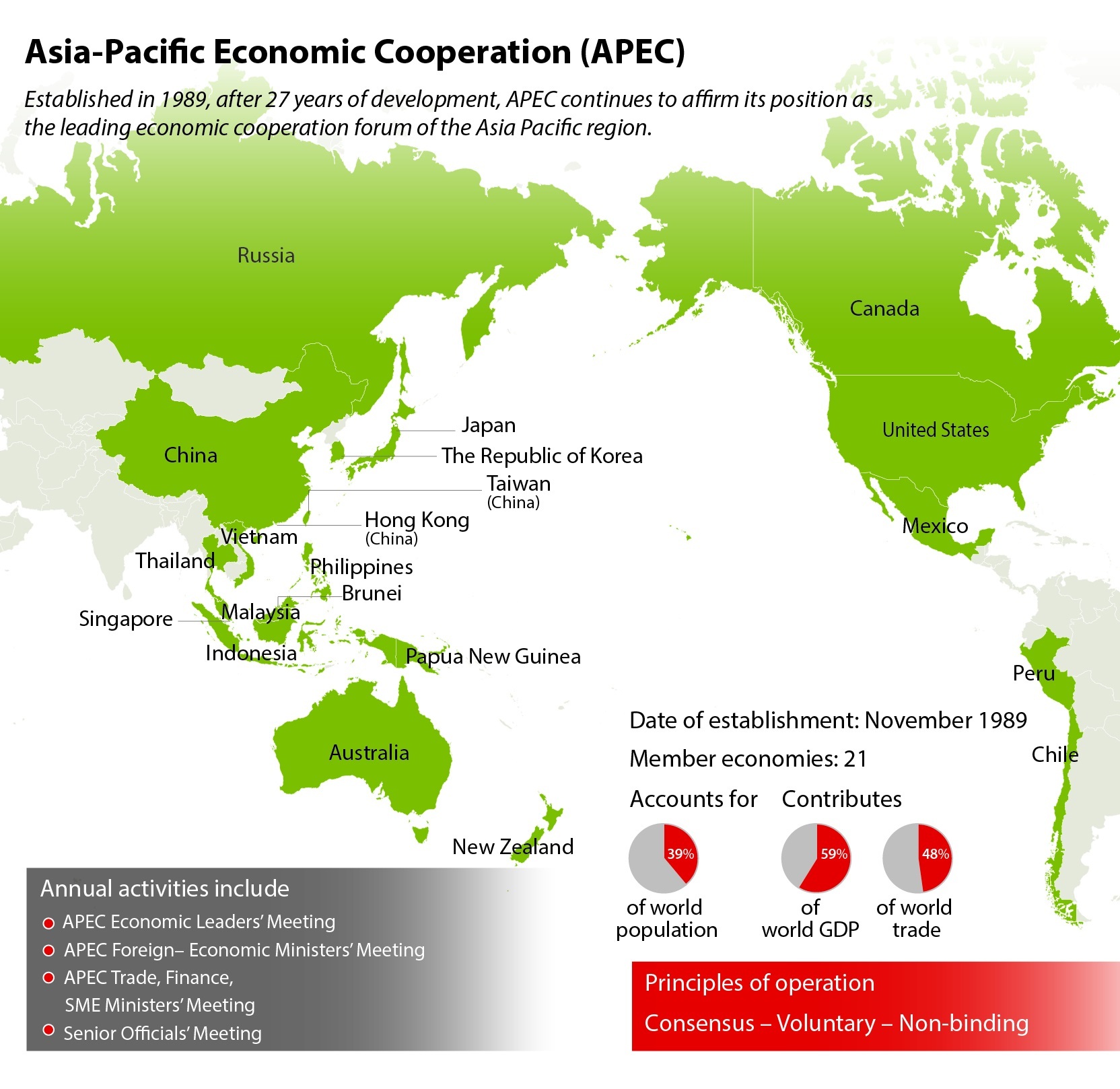
- Establishment: Created in 1989 as a regional economic forum to enhance the growing interdependence of the Asia-Pacific region.
- Objective: Promote balanced, inclusive, sustainable, innovative, and secure growth, and accelerate regional economic integration.
- Membership: Comprises 21 member economies- Australia, Brunei, Canada, Chile, China, Hong Kong, Indonesia, Japan, South Korea, Malaysia, Mexico, New Zealand, Papua New Guinea, Peru, the Philippines, Russia, Singapore, Taiwan, Thailand, the United States, and Vietnam.
- Secretariat: Headquartered in Singapore, coordinating policy dialogues, working groups, and capacity-building across member economies.
- Decision-Making Principle: Functions on voluntary, non-binding, and consensus-based commitments rather than treaty obligations.
- Economic Scale: Represents 2.9 billion people, accounting for ~60% of global GDP and ~48% of global trade.
- Terminology: Refers to its members as “economies” (not countries) to accommodate non-sovereign entities like Hong Kong and Taiwan.
- Major Frameworks:
- Bogor Goals (1994) – Free and open trade and investment in the Asia-Pacific.
- APEC Putrajaya Vision 2040 – Envisions an open, dynamic, resilient, and peaceful Asia-Pacific community by 2040.
- Focus Areas: Trade liberalisation, digital economy, supply chain resilience, sustainable energy, and inclusive growth.
India and APEC:
- Membership: India is NOT a member but has shown consistent interest since the early 1990s, aligning with its Look East / Act East Policy.
- Geographical Criterion: APEC’s membership is limited to Asia-Pacific economies, while India is categorised under South Asia, restricting eligibility.
- Economic Context: India’s gradual liberalisation in the 1990s contrasted with APEC’s open market orientation, reducing its early appeal to members.
- Political Resistance: China has reportedly opposed India’s entry to maintain regional influence and prevent rival power balancing.
- Moratorium: A 1997 freeze on new memberships continues to block India’s formal inclusion.
- Current Engagement: Participates in Track-II dialogues, observer consultations, and partner discussions with APEC economies.
- Strategic Significance:
- APEC economies drive 60% of world GDP and 48% of global trade.
- Membership would improve market access, FDI inflows, and digital integration.
- Enhances India’s engagement with U.S., Japan, China, and ASEAN through multilateral diplomacy.
- Alternative Platforms: India engages APEC members via BRICS, QUAD, IPEF, and RCEP-linked forums, expanding Indo-Pacific economic influence.
- Future Outlook: Once the moratorium is lifted, India’s robust economic scale, digital economy, and supply chain capacity make it a strong candidate for future APEC membership.
| With reference to `Asia Pacific’ Ministerial Conference on Housing and Urban Development (APMCHUD)’, consider the following statements:
1. The first APMCHUD was held in India in 2006 on the theme `Emerging Urban Forms – Policy Responses and Governance Structure’. 2. India hosts all the Annual Ministerial Conferences in partnership with ADB, APEC and ASEAN. Which of the statements given above is/are correct? Options: (a) 1 only (b) 2 only (c) Both 1 and 2 (d) Neither 1 nor 2* |