International Relations/Bilateral Relations
India’s exit from the Ayni Airbase in Tajikistan
Why in the News?
India’s complete pullout from the Ayni Airbase in Tajikistan (in 2022), its sole foreign military post, drew sharp opposition's criticism.
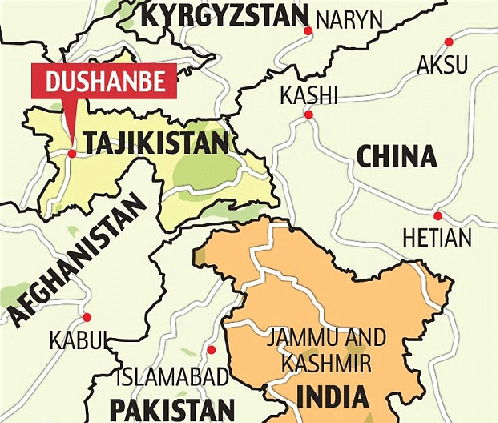
About Ayni Airbase:
- Location: Situated 10 km west of Dushanbe, Tajikistan, near the Afghanistan border via the Wakhan Corridor, and about 20 km from Pakistan-occupied Kashmir (PoK).
- Also known as: Known as Gissar Air Base or Gissar Military Aerodrome; originally a Soviet-era base later modernised by India.
- Development by India: Upgraded by India in the early 2000s under a bilateral agreement with Tajikistan; India invested ~USD 100 million to extend the runway (3,200 m), build hangars, depots, and control systems.
- Operational Role: Hosted IAF helicopters and Su-30MKI fighters, with ~200 Indian personnel managing repair and training operations; also supported humanitarian and evacuation missions, notably during the 2021 Taliban takeover.
- Predecessor: Replaced Farkhor Airbase (1998–2008), India’s earlier base used for supporting the Northern Alliance in Afghanistan.
Strategic Significance of the Airbase:
- Forward Presence: Gave India surveillance and strike reach over Afghanistan and Pakistan’s western front.
- Regional Leverage: Enhanced India’s defence footprint in Central Asia, countering China’s BRI and Russian influence.
- Operational Hub: Supported the then anti-Taliban Northern Alliance and India’s broader Connect Central Asia Policy (2012).
- Evacuation & Logistics Node: Enabled rapid crisis evacuation and regional logistical operations.
- Geopolitical Symbolism: Marked India’s aspiration for a continental strategic presence; its closure reflects shrinking influence west of the Himalayas amid Russia–China consolidation.
Reasons for India’s Exit:
- Lease Expiry: The bilateral lease expired in 2022 and was not renewed by Tajikistan.
- External Pressures: Russia and China discouraged Tajikistan from extending India’s presence.
- Strategic Shift: Diminished relevance post-Taliban’s return (2021) and collapse of India’s Afghan network.
- Operational Constraints: High costs, limited autonomy, and dependence on Russian logistics reduced viability.
- Reorientation: Strategic focus moved toward the Indo-Pacific and maritime partnerships.
| Consider the following countries :
1. Azerbaijan 2. Kyrgyzstan 3. Tajikistan 4. Turkmenistan 5. Uzbekistan Which of the above have borders with Afghanistan? Options: (a) 1, 2 and 5 only (b) 1, 2, 3 and 4 only (c) 3, 4 and 5 only* (d) 1, 2, 3, 4 and 5 |
Syllabus mapping