ISRO and the next big challenge
Why in the News
ISRO’s recent string of successes, routine PSLV launches, Chandrayaan-3’s lunar landing, Aditya-L1’s solar orbit insertion, and the India-US NISAR mission has raised expectations sharply. Now for the first time, India’s challenge is no longer technological proof-of-concept but institutional maturity. Furthermore, India’s space programme is preparing for multiple high-complexity missions in parallel, including Gaganyaan, Chandrayaan-4, and the Next Generation Launch Vehicle (NGLV).
Why is ISRO’s recent success described as “raising the bar”?
- Mission Reliability: Sustained success of the Polar Satellite Launch Vehicle has made reliable access to orbit almost routine.
- Planetary Achievement: Chandrayaan-3’s soft landing on the Moon in August 2023 placed India among a small group of lunar-landing nations.
- Solar Science Capability: Aditya-L1’s successful halo orbit insertion in January 2024 added a dedicated solar observatory to ISRO’s portfolio.
- International Collaboration: Launch of the NASA-ISRO Synthetic Aperture Radar (NISAR) mission demonstrated high-value global scientific cooperation.
What fundamental shift can be identified in ISRO’s challenge?
- Institutional Transition: Moves focus from individual scientific feats to sustained organisational performance.
- Parallel Complexity: Requires simultaneous execution of human spaceflight, deep-space missions, and commercial launches.
- Expectation Management: Makes failure costlier as public, political, and international scrutiny increases.
How does mission parallelisation strain ISRO’s existing systems
- Human Spaceflight Load: Gaganyaan preparation consumes engineering, testing, and safety-certification bandwidth.
- Science Programme Pressure: Planetary, solar, and Earth-observation missions compete for limited skilled manpower.
- Launch Vehicle Bottlenecks: GSLV and future NGLV development face cadence and scale constraints.
Why are industrial capacity and regulatory clarity critical for ISRO’s next phase?
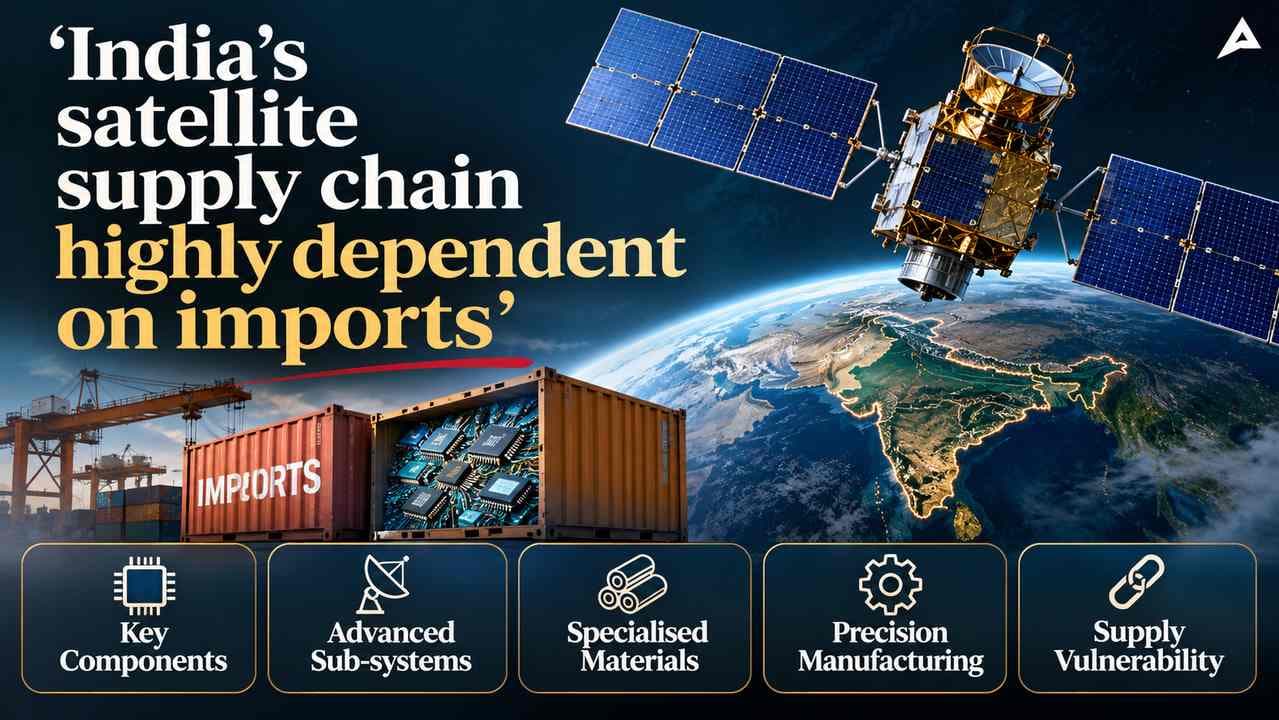
- Industrial Capacity: Current supplier base lacks depth to absorb shocks or scale production without delays.
- Supply Chain Fragility: Over-reliance on ISRO facilities makes anomalies system-wide bottlenecks.
- Regulatory Ambiguity: Absence of a clear space law creates uncertainty around liability, insurance, and commercial risk allocation.
What role does the private space ecosystem play in this transition?
- Commercial Dependence: Private launch providers remain reliant on ISRO infrastructure and expertise.
- Institutional Separation: IN-SPACe and NSIL must evolve from facilitation bodies to autonomous regulatory and commercial entities.
- Routine Operations: Private participation is necessary to make launches, manufacturing, and satellite services routine rather than exceptional.
Why is governance reform central to ISRO’s next phase?
- Legal Authority: ISRO lacks statutory backing for authorisation, dispute resolution, and commercial oversight.
- Regulatory Burden: Ad-hoc decisions persist due to absence of a comprehensive space law.
- Systemic Resilience: Institutionalised processes are required to reduce dependence on individual leadership or mission-specific improvisation.
Conclusion
ISRO's future success depends on its ability to transform from a mission-centric organisation into a mature space institution, supported by industrial depth, legal clarity, and governance reform. The decisive test is whether India’s space programme can make complexity routine without diluting reliability.
PYQ Relevance
Discuss India’s achievements in the field of Space Science and Technology. How has the application of this technology helped India in its socio-economic development?
Linkage: This PYQ tests understanding of India’s space capabilities and their role in national socio-economic development. The article advances this by highlighting the need to move from mission successes to institutional sustainability, regulatory clarity, and routine execution to sustain long-term benefits.